Causality in Communication Science
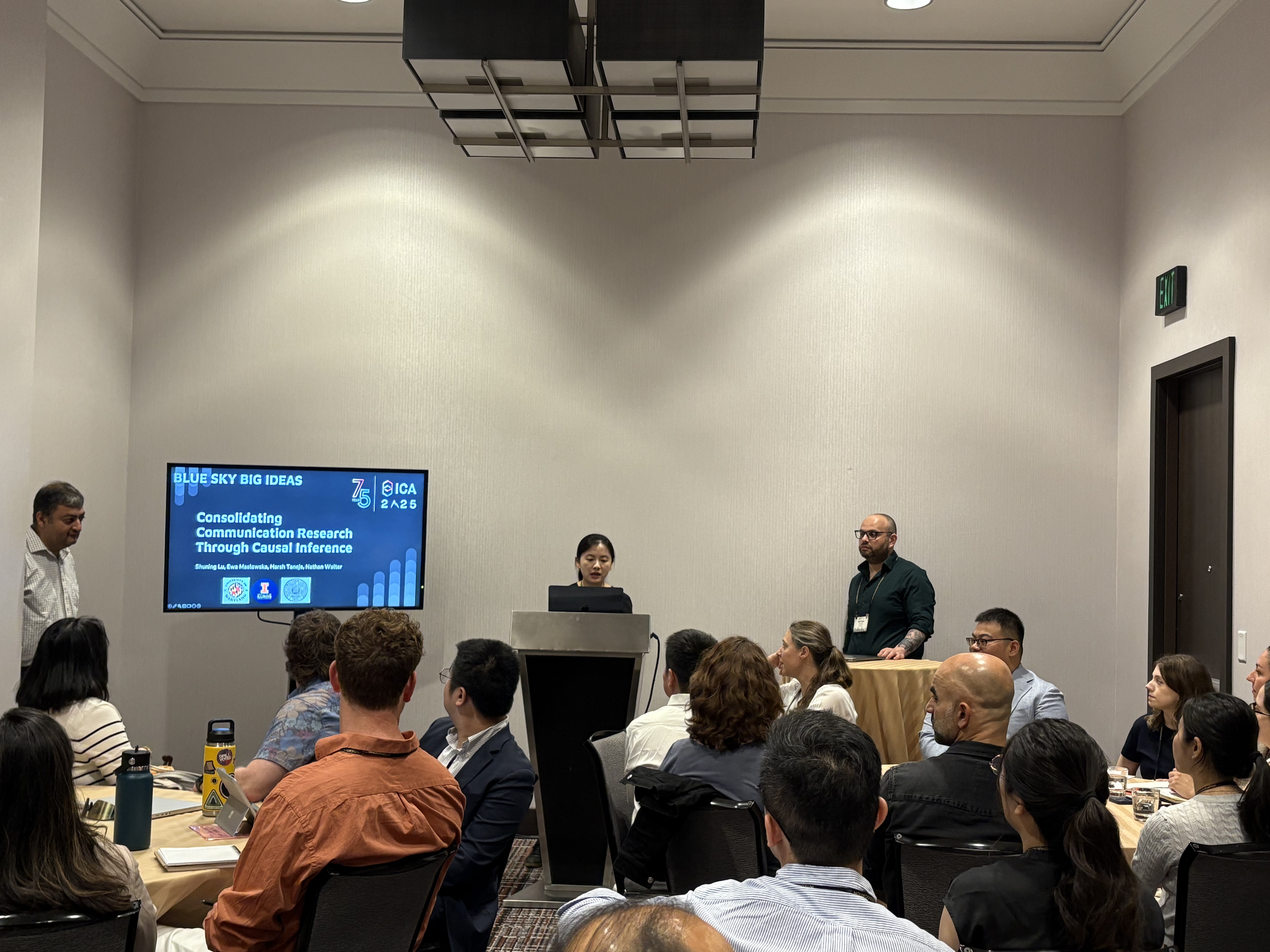
Blue Sky Big Ideas Workshop Presented at ICA 2025
View the Project on GitHub museresearch/causality_communication
Consolidating Communication Research Through Causal Inference
About the Workshop
The societal impact of communication motivated the establishment of communication studies. However, establishing causality within the field remains challenging, especially in technologically mediated contexts. Communication is a diverse field, and causal interpretations vary across traditions. This workshop will explore how different subfields address causality, emphasizing the need for causal explanations to enhance theory building. It will also discuss methodological approaches, challenges, and future directions for establishing causality in communication research.
Session Goals
Communication scholars are keen on understanding the cause and effects of various communication phenomena in both interpersonal and mediated contexts, and many communication theories are in fact causal. While the question of causality is not new, it has recently attracted more attention because of the unprecedented prevalence of digital trace data, which along with the availability of various publicly accessible datasets, provide unique opportunities for communication scholars to ask innovative research questions with causal inference based on observational data, yielding greater ecological validity. However, institutions have yet to incorporate these methodological advancement in their curricula. This workshop will introduce and discuss modern causal inference methods, more common in other social sciences, that can be used to determine a true cause-and-effect relationship in both quantitative and qualitative communication science. Specifically, we will focus on how communication researchers could harness causal inference thinking, designs and methods to advance their inquiries into communication phenomena.
Outcomes
We are a very dispersed discipline and even the definition of what is “causal” differs by communication subfield. Therefore, the goal is to learn how the different subfields of communication engage with the issue and learn from each other. We hope that the workshop will lead to a discussion about a possible special issue and a development of a more organized group of researchers interested in causality in communication science.
Organizers
Shuning Lu
Philip Merrill College of Journalism, University of Maryland, College Park
Ewa Maslowska
Institute of Communications Research, University of Illinois Urbana-Champaign
Harsh Taneja
Institute of Communications Research, University of Illinois Urbana-Champaign
Nathan Walter
School of Communication, Northwestern University
Speakers
Helena Bilandzic
Department of Media, Knowledge, and Communication, University of Augsburg
Pascal Jürgens
Trier University
Sebastian Valenzuela
School of Communications, Pontificia Universidad Católica de Chile
Tian Yang
School of Journalism and Communication, The Chinese University of Hong Kong
Guiding questions
- How, if at all, can we use causal inference to develop new theories and sunset older ones?
- Should we consider ‘relaxing’ key requirements of causal inference when studying and theorizing about communication in the real-world?
- What kind of data is needed to make causal inferences across levels of analysis (e.g., individuals, teams, communities, societies)?
- What is the role of causal inference in qualitatively-driven inquiry and community-based participatory research?